
Running digital ads is easy. Running profitable digital ads is not.
Businesses today spend thousands—or even lakhs—on Google Ads, Meta Ads, LinkedIn Ads and other digital advertising platforms. But getting impressions, clicks and traffic doesn’t necessarily mean you’re getting business growth.
The real question is:
Are your advertising campaigns generating enough revenue to justify what you’re spending?
That’s where performance marketing comes in.
Performance marketing focuses on measurable business outcomes such as leads, sales, conversions, customer acquisition and revenue. Instead of simply increasing traffic or visibility, the goal is to continuously improve campaign performance and make every advertising rupee work harder.
In 2026, with increasing competition, higher advertising costs, smarter AI-powered campaign optimization and customers moving across multiple digital touchpoints, businesses need a more strategic approach to paid advertising.
In this guide, we’ll explain what performance marketing is, why ROAS matters, how to reduce wasted ad spend and the strategies businesses can use to build more profitable campaigns.
What Is Performance Marketing?
Performance marketing is a data-driven digital marketing approach where campaigns are measured and optimized based on specific business outcomes.
These outcomes can include:
- Website purchases
- Qualified leads
- Phone calls
- Form submissions
- App installations
- Online bookings
- Product enquiries
- Subscription sign-ups
- Revenue
Unlike traditional advertising, where success can be difficult to measure, performance marketing relies heavily on data and measurable results.
For example, instead of saying:
“Our campaign reached 500,000 people.”
A performance marketer asks:
“How many qualified customers did we acquire and how much revenue did the campaign generate?”
That difference is important.
Reach and impressions are useful—but business outcomes are what ultimately matter.
Why ROAS Matters in Performance Marketing
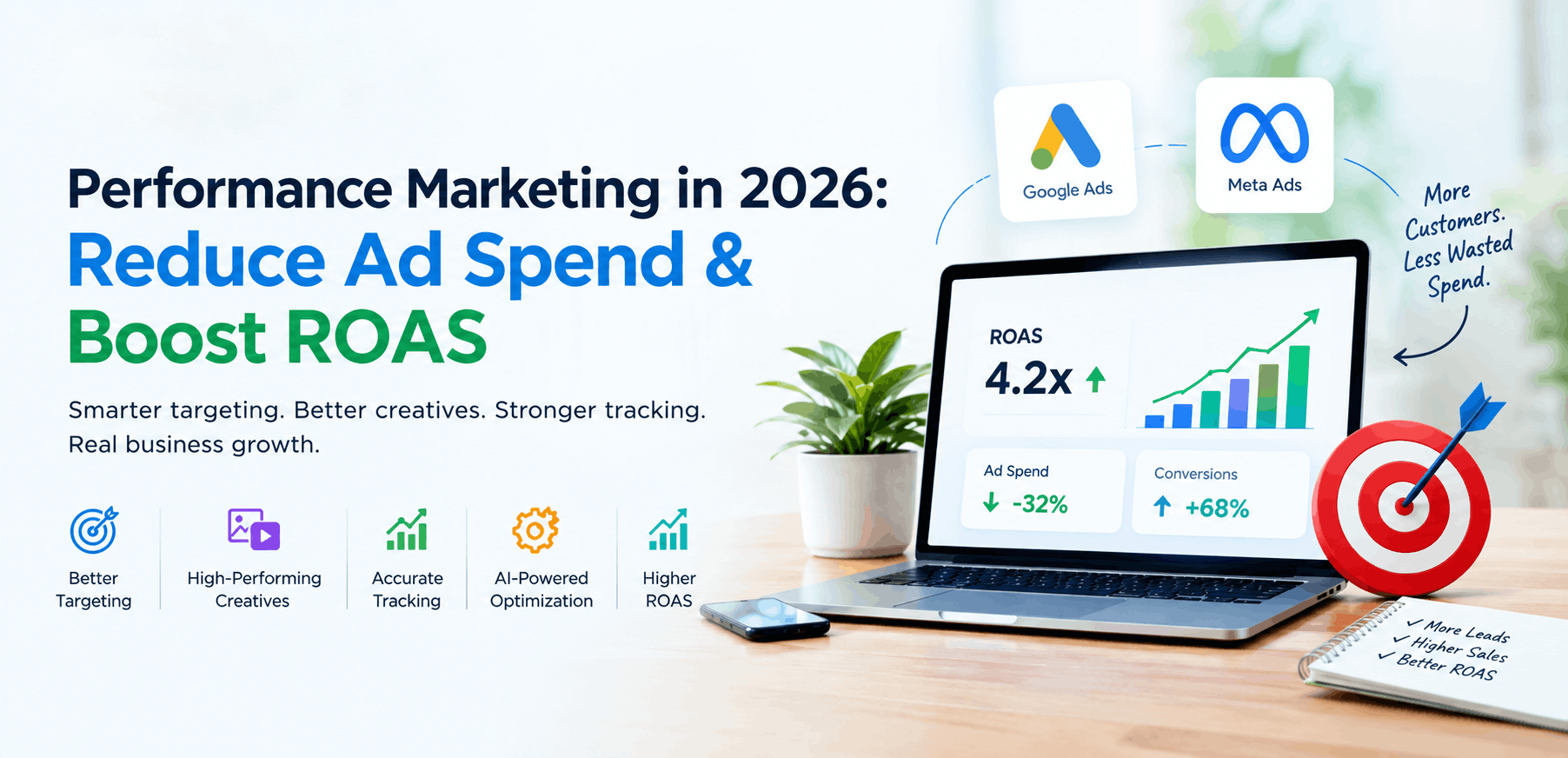
One of the most important performance marketing metrics is ROAS, or Return on Ad Spend.
The basic formula is:
ROAS = Revenue Generated ÷ Advertising Spend
For example, suppose a business spends ₹1,00,000 on advertising and generates ₹4,00,000 in tracked revenue.
Its ROAS would be:
₹4,00,000 ÷ ₹1,00,000 = 4X ROAS
This means the business generated ₹4 in tracked revenue for every ₹1 spent on advertising.
However, ROAS should not be viewed in isolation.
A campaign with a high ROAS isn’t automatically profitable if product costs, shipping, salaries, discounts, agency fees, taxes and other expenses significantly reduce the actual profit.
That’s why businesses should look at ROAS alongside metrics such as:
- Customer Acquisition Cost (CAC)
- Cost Per Lead (CPL)
- Cost Per Acquisition (CPA)
- Conversion Rate
- Average Order Value (AOV)
- Customer Lifetime Value (LTV)
- Gross Margin
- Revenue
- Profit
7 Ways to Reduce Ad Spend and Increase ROAS
Reducing advertising costs doesn’t necessarily mean spending less money.
In many cases, the smarter approach is to eliminate wasted spend and invest more in campaigns, audiences, keywords and creatives that generate meaningful results.
Here are seven strategies businesses can use.
1. Improve Your Audience Targeting
Showing an advertisement to everyone is rarely an efficient strategy.
Your target audience should be based on factors such as:
- Location
- Age
- Interests
- Search intent
- Previous website activity
- Purchase behavior
- Customer lists
- Business type
- Industry
- Stage of the buying journey
For example, an e-commerce brand selling premium skincare products shouldn’t necessarily target everyone interested in beauty.
A more focused strategy could involve targeting people who demonstrate relevant purchase intent and then building remarketing audiences from visitors and previous customers.
The more relevant the audience, the greater the potential for your advertising budget to generate meaningful results.
Pro tip:
Don’t optimize your campaigns only for clicks.
Optimize them for the conversion that actually matters to your business.
2. Fix Your Conversion Tracking
You can’t optimize what you can’t measure.
Poor conversion tracking is one of the biggest problems in performance marketing.
If your advertising platform doesn’t accurately understand which users are converting, campaign optimization becomes much more difficult.
Depending on the business, conversion tracking could include:
- Purchases
- Lead forms
- WhatsApp enquiries
- Phone calls
- Demo requests
- Bookings
- Account registrations
- Downloads
- Qualified leads
Your tracking setup should connect advertising activity with actual business outcomes as accurately as possible.
For e-commerce businesses, this can mean tracking revenue and purchase value.
For lead-generation businesses, simply counting every form submission may not be enough. A better approach is to identify which leads become qualified opportunities or customers.
Better data leads to better optimization decisions.
3. Create Better Ad Creatives
Your targeting can be excellent, but poor creative can still hurt campaign performance.
People scroll quickly through social feeds and are exposed to countless advertisements every day.
Your creative needs to communicate the value of your offer quickly.
Effective ad creatives typically focus on:
- A clear hook
- A specific customer problem
- A compelling benefit
- Strong visual communication
- Relevant social proof
- A clear call-to-action
Instead of simply saying:
“We provide digital marketing services.”
A more specific message could focus on the outcome:
“Turn More Website Visitors Into Qualified Leads With Data-Driven Digital Marketing.”
Different audiences respond to different messages, so testing multiple creative concepts is important.
Test variations in:
- Headlines
- Images
- Videos
- Offers
- Calls-to-action
- Formats
- Messaging
Then let campaign data guide your decisions.
4. Optimize Your Landing Pages
Sometimes the advertising campaign isn’t the problem.
The landing page is.
Imagine someone clicks your ad because they’re interested in a service, but the landing page:
- Loads slowly
- Looks outdated
- Doesn’t match the advertisement
- Has too much text
- Has no clear CTA
- Doesn’t build trust
- Makes the enquiry process complicated
That click has already cost you money.
A high-performing landing page should make it easy for visitors to understand:
What are you offering?
Why should they choose you?
What should they do next?
Consider improving:
- Page speed
- Mobile responsiveness
- Headlines
- CTA placement
- Forms
- Testimonials
- Trust signals
- Product/service information
- Visual hierarchy
Even a small improvement in conversion rate can have a significant effect on overall campaign economics.
5. Use AI and Automated Campaign Optimization Carefully
AI is playing an increasingly important role in digital advertising.
Advertising platforms can use machine learning to help with:
- Audience optimization
- Bidding
- Budget allocation
- Creative combinations
- Conversion prediction
- Search query matching
- Campaign optimization
But automation doesn’t eliminate the need for strategy.
Businesses still need to provide the platforms with:
- Accurate conversion data
- Clear campaign objectives
- Quality creative assets
- Appropriate budgets
- Relevant audiences
- Strong offers
- Reliable first-party data
Think of AI as an optimization engine—not a replacement for marketing strategy.
The quality of the inputs still matters.
6. Use First-Party Data
As the digital advertising ecosystem evolves, businesses need to pay greater attention to the customer data they collect directly.
First-party data can include:
- Customer email addresses
- Purchase history
- Website interactions
- CRM data
- Previous leads
- Customer preferences
- Subscription information
With appropriate consent and privacy practices, this data can help businesses understand customers and create more relevant marketing experiences.
For example, an e-commerce business can segment customers based on previous purchases and create campaigns designed around repeat purchases or complementary products.
The goal isn’t simply to collect more data.
It’s to use reliable customer data to make better marketing decisions.
7. Continuously Test and Optimize
Performance marketing isn’t a “set it and forget it” activity.
Campaign performance can change because of:
- Competition
- Seasonality
- Consumer behaviour
- Creative fatigue
- Market demand
- Product pricing
- Offers
- Platform changes
That’s why ongoing testing is essential.
You can test:
Creative
Different images, videos, hooks, headlines and messaging.
Audience
Different customer segments, remarketing groups and prospecting audiences.
Landing Pages
Different layouts, headlines, CTAs and offers.
Offers
Different discounts, bundles, incentives or value propositions.
Campaign Structure
Different campaign objectives, bidding strategies and budget allocations.
The goal is to build a continuous test → measure → learn → optimize cycle.
Google Ads vs Meta Ads for Performance Marketing
Google Ads and Meta Ads can both be powerful performance marketing channels, but they often play different roles in the customer journey.
Google Ads
Google Ads can be particularly useful when people are actively searching for a product or service.
For example:
“digital marketing agency near me”
or
“best accounting software for small business”
The user is already expressing some level of intent.
Google Ads can therefore be useful for capturing existing demand.
Common Google Ads formats include:
- Search Ads
- Shopping Ads
- Display Ads
- YouTube Ads
- Performance Max campaigns
Meta Ads
Meta’s advertising ecosystem—including Facebook and Instagram—can be useful for creating demand, reaching specific audiences, promoting products, generating leads and remarketing to potential customers.
Meta campaigns can use a combination of:
- Images
- Videos
- Reels
- Carousels
- Stories
- Lead forms
- Product catalogues
For many brands, Meta is especially useful for visually communicating products, offers and brand stories.
Should You Choose Google Ads or Meta Ads?
There isn’t one platform that is automatically right for every business.
The appropriate mix depends on factors such as:
- Business model
- Customer journey
- Search demand
- Product category
- Average order value
- Sales cycle
- Target audience
- Creative assets
- Campaign objectives
- Budget
In some cases, Google Ads may capture existing demand while Meta helps generate and nurture demand.
For other businesses, one platform may be more relevant than the other.
The important thing is to measure the business outcome, rather than simply comparing clicks or impressions.
ROAS vs ROI vs CAC: What’s the Difference?
These terms are often used interchangeably, but they measure different things.
ROAS — Return on Ad Spend
Measures revenue generated relative to advertising spend.
Formula:
Revenue ÷ Ad Spend
ROI — Return on Investment
Looks at the return from an investment after considering the relevant costs.
A simplified formula is:
(Return − Investment Cost) ÷ Investment Cost × 100
ROI provides a broader financial perspective than ROAS.
CAC — Customer Acquisition Cost
CAC measures how much it costs to acquire a customer.
A simplified formula is:
Total Customer Acquisition Costs ÷ Number of New Customers
For example, if a business spends ₹2,00,000 on sales and marketing and acquires 100 new customers:
CAC = ₹2,000
Businesses should consider CAC alongside customer lifetime value.
If acquiring a customer costs ₹2,000 but that customer generates significantly more contribution over their relationship with the business, the acquisition economics may be sustainable.
Common Performance Marketing Mistakes That Waste Ad Budget
Even businesses with significant advertising budgets can waste money through avoidable mistakes.
Here are some common examples.
1. Optimizing for vanity metrics
High impressions and clicks don’t necessarily mean high revenue.
2. Running campaigns without proper conversion tracking
Without reliable data, optimization becomes guesswork.
3. Sending every advertisement to the homepage
A dedicated landing page can often provide a more relevant experience.
4. Using the same creative for months
Creative fatigue can reduce engagement and performance.
5. Targeting too broadly
Large audiences aren’t automatically better audiences.
6. Making decisions too quickly
Campaigns need sufficient data before meaningful conclusions can be drawn.
7. Ignoring the sales process
A marketing campaign can generate leads, but if sales follow-up is slow or inconsistent, those leads may not turn into customers.
8. Measuring only platform-reported numbers
Advertising platforms provide valuable reporting, but businesses should also compare campaign data with their own CRM, analytics, sales and revenue data.
How to Build a High-Performance Marketing Funnel
Performance marketing works best when you consider the entire customer journey.
A simplified funnel might look like this:
Awareness → Interest → Consideration → Conversion → Retention
Awareness
Introduce your business to relevant potential customers.
Interest
Provide useful content, compelling creative and relevant offers.
Consideration
Use testimonials, case studies, product information and comparisons to build confidence.
Conversion
Make it easy for customers to purchase, enquire, book or contact you.
Retention
Continue engaging existing customers through relevant communication, remarketing and offers.
The biggest opportunity isn’t always getting more people into the funnel.
Sometimes the opportunity is improving the percentage of people who move from one stage to the next.
How Much Should You Spend on Performance Marketing?
There is no universal advertising budget that works for every business.
Your budget should depend on factors such as:
- Revenue targets
- Customer acquisition cost
- Average order value
- Customer lifetime value
- Profit margins
- Market size
- Competition
- Sales capacity
- Conversion rates
A better question than:
“How much should I spend on ads?”
is:
“How much can I sustainably spend to acquire a customer while maintaining healthy business economics?”
Once you understand your target CAC and expected customer value, you can make more informed decisions about advertising budgets.
Performance Marketing in 2026: What Businesses Should Focus On
The performance marketing landscape continues to evolve.
Businesses should pay particular attention to:
AI-powered optimization
Automation is becoming increasingly integrated into advertising platforms.
First-party data
Direct customer relationships and responsibly collected first-party data are becoming increasingly important.
Creative quality
As targeting becomes increasingly automated, strong creative and compelling offers remain critical.
Full-funnel measurement
Businesses need to understand what happens after the click—not just what happens inside the advertising platform.
Profit-focused marketing
Revenue and ROAS are useful, but businesses ultimately need to understand profitability.
Better customer experiences
Fast websites, relevant landing pages, simple forms and seamless buying journeys can significantly influence advertising efficiency.
The Future of Performance Marketing Is About Better Decisions, Not Just More Ads
Performance marketing isn’t about spending more money.
It’s about making better decisions with the money you’re already spending.
The strongest performance marketing strategies connect:
Data + Creative + Technology + Strategy + Customer Experience
When these elements work together, businesses can identify where their advertising budget is producing results, where money is being wasted and where there are opportunities to improve.
The goal shouldn’t simply be:
“Get more clicks.”
It should be:
“Generate more valuable customers at a sustainable cost.”
Final Thoughts
Performance marketing has become an essential growth channel for businesses that want measurable results from digital advertising.
But successful campaigns require more than launching Google or Meta Ads.
You need:
- Accurate tracking
- Clear business objectives
- The right audience
- Strong creative
- High-converting landing pages
- Continuous testing
- Data-driven optimization
- A clear understanding of CAC, ROAS, ROI and customer value
Most importantly, performance marketing should be connected to actual business results.
At Good Old Geek, we believe digital marketing should do more than create impressions. It should help businesses attract the right audience, generate meaningful opportunities and build measurable growth.
If your advertising campaigns are generating clicks but not enough customers, it may be time to rethink your strategy.
Don’t just spend more on advertising. Make your advertising work harder.
Ready to Improve Your Performance Marketing?
Whether you’re looking to generate more leads, increase online sales, improve ROAS or build a scalable paid advertising strategy, the right approach starts with understanding your numbers.
Let’s turn your advertising budget into measurable business growth.
Good Old Geek — Digital Marketing That Works.